


Listen to This Episode
“What Would You Make If You Stopped Judging Your Art So Soon?” on:
What Would You Make If You Stopped Judging Your Art So Soon?
You begin with an idea.
There is a little energy in it. A line you like. An image you can almost see. A scene, melody, movement or story that makes you curious.

Then the judgment begins.
This is not good enough.
Someone else has already done it better.
That line is embarrassing.
Nobody will care about this.
Maybe I should start again.
Perfectionism does not always stop artists before they begin. Sometimes it allows us to begin, then destroys the momentum before the work has had a chance to become anything.
We start judging the first attempt as if it were the final result.
And eventually, we stop.
When Editing Stops Helping
I once took a piece of writing I liked and edited it until I did not like it anymore.
I kept returning to it.
I changed the opening. I moved sentences. I replaced words. I tried to make the piece clearer, stronger and more impressive.
Every edit was supposed to make it better.
But somewhere along the way, I stopped listening to what the piece needed. Instead, I started listening to every criticism someone might possibly make of it.
By the time I finished, the writing may have been cleaner.
It was also flatter.
I had edited some of the life out of it.
Editing is not the enemy. Artists need discernment. We need to practise, revise, cut, adjust and improve.
But there is a difference between helping a piece become clearer and refusing to let it exist unless it arrives fully formed.
Sometimes what we call high standards is fear arriving with a red pen.
The Artist and the Editor Have Different Jobs
Creating and evaluating are both necessary.
They are simply not the same job.
The artist follows the idea.
The editor steps back and assesses it.
The artist asks:
What happens next?
What am I noticing?
What wants to be said?
What would happen if I tried this?
The editor asks:
Is this clear?
Does this belong?
Is there a stronger choice?
What needs to be removed?
Both sets of questions matter. The problem begins when the editor arrives before the artist has finished speaking.
Imagine trying to tell someone a story while they correct every sentence before you reach the end of it.
Eventually, you lose your train of thought.
You may even decide the story is not worth telling.
That is what can happen inside the creative process. We try to make the thing and assess the thing at the same time.
The result is often not excellence.
It is paralysis.
Your First Attempt Cannot Carry the Weight of Your Identity
A new piece of work can feel strangely personal.
It is not only a paragraph. It becomes proof that you can or cannot write.
It is not only an audition. It becomes proof that you are or are not talented.
It is not only a sketch. It becomes evidence that you have either grown or wasted your time.
No wonder we judge so quickly.
We are asking the work to answer questions it cannot answer.
Am I a real artist?
Do I still have it?
Will anyone choose me?
Does my voice matter?
A rough idea cannot safely carry all of that.
Its first job is not to prove your talent, justify your calling or guarantee a result.
Its first job is to exist.
You need something on the page before you can revise the page.
You need to try the choice before you can know whether it works.
You need to sing the melody before you can hear what it wants to become.
You need to make something before you decide what making it says about you.
Perfectionism Often Makes the Work Safer
Perfectionism can present itself as a commitment to excellence.
Sometimes it is really a commitment to avoiding exposure.
We remove the strange sentence.
We soften the bold idea.
We explain the part that might be misunderstood.
We replace the choice that sounds like us with something more familiar.
We try to make the work difficult to criticise.
But art that cannot be criticised is often art that has taken very few risks.
Your voice may not first appear in the polished parts. It may appear in the line you almost deleted because it felt too direct, too odd or too much like you.
This does not mean every unusual idea should stay.
It means you should allow the idea to arrive before deciding what must leave.
You do not improve your work by distrusting it from the moment it is born.
Create First. Evaluate Later.
The shift is simple:
Create first.
Evaluate later.
Not because quality does not matter, but because judgment has a proper time.
Choose one idea you have been circling.
It might be a page, a painting, a scene, a song, a pitch, a poem, a video or a piece of choreography.
Set a timer for twenty minutes.
For those twenty minutes, do not improve it.
Continue it.
Do not return to the opening.
Do not delete the awkward sentence.
Do not research whether someone else has already done something similar.
Do not ask another person whether it is good.
Do not begin planning how you will sell it.
Add to it.
Follow it.
See where it goes.
You can edit it later. You can decide it does not work later. You can even abandon it later.
But do not abandon it before you have properly met it.
As you work, ask:
What is trying to emerge here before I make it presentable?
That question gives the work room to reveal itself.
Starting Before You Feel Ready
The audacity to create is not believing that everything you make will be wonderful.
It is not constant confidence.
It is not freedom from criticism.
It is the willingness to make something before you know what it will become.
The artist in you needs moments when the outcome is not being measured.
Moments when the idea does not have to become content, income, proof, a finished product or a public success.
It can simply be something you are making.
You may still judge it eventually.
You probably should.
But then you will be responding to something that exists, rather than preventing it from existing at all.
So here is the question:
What would you make this week if the first version did not have to prove anything about you?
Let it be awkward.
Let it surprise you.
Let it exist long enough to tell you what it might become.
Go Deeper with Audacious Artistry
If this episode spoke to something in you, my book Audacious Artistry: Reclaim Your Creative Identity and Thrive in a Saturated World goes deeper.
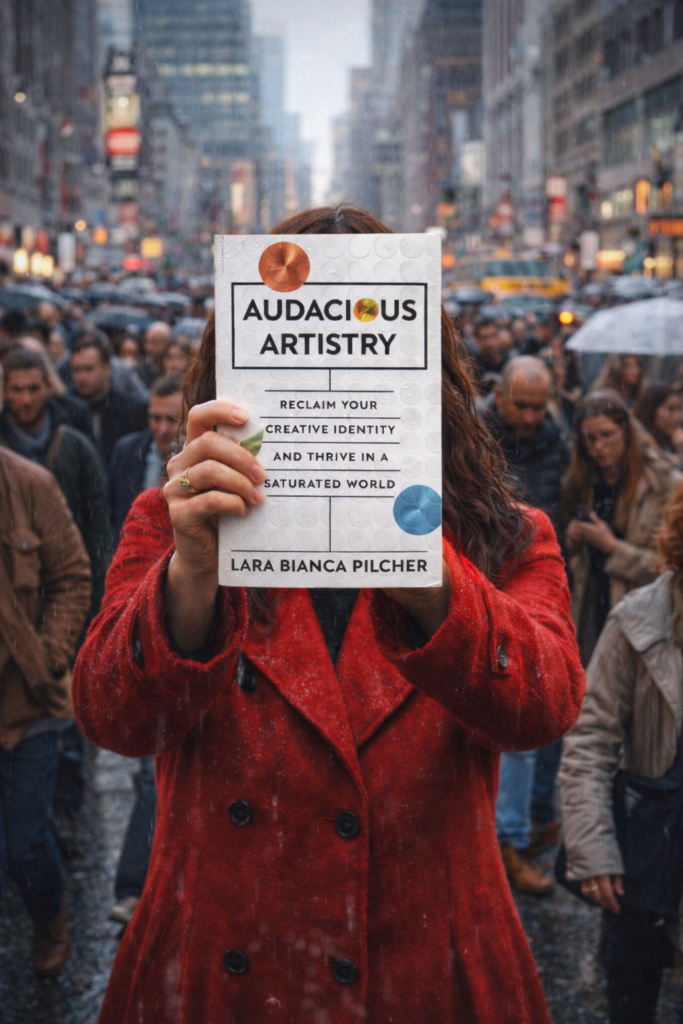
It’s written for artists and creatives who still feel called to create but are tired of proving, comparing, waiting for permission, or wondering if their work still matters.
You can also download the free 10-week Audacious Artistry Group Study Guide and walk through the book on your own, with a friend, or with a group of artists.
Read the book + get the free guide:
https://larabiancapilcher.com/book
This article is adapted from the Healthy Wealthy Wise Artist Podcast episode:
Listen to This Episode
“What Would You Make If You Stopped Judging Your Art So Soon?” on:
Or visit the podcast page:
https://larabiancapilcher.com/podcast
With you as you keep creating,
— Lara Bianca Pilcher
Connect with Lara
Website:
https://larabiancapilcher.com
Instagram:
https://instagram.com/larabiancapilcher







Build a life of love, purpose, adventure & boundless creativity!