


Listen to This Episode
“Why 10,000 Views Can Matter Less Than One Right Person“ on:
Why 10,000 Views Can Matter Less Than One Right Person
Artists are living in a very strange time.
We can see numbers everywhere.
Views.
Followers.
Likes.
Subscribers.
Downloads.
Sales.
And because those numbers are public, they can start to look like proof.
Proof that someone is important.
Proof that someone is successful.
Proof that somebody else is ahead.
But I keep coming back to a question:
What if the people who matter most are not always the largest number of people?
Because sometimes 10,000 people can scroll past something…
and one person can change your career.

Big Numbers Can Matter — But They Don’t Tell the Whole Story
I am not anti-audience.
I am not anti-reach.
I am not anti-growth.
Follower counts can matter.
Views can matter.
If you are selling art, tickets, books, music or creative services, a larger audience can create more opportunity.
And when you see someone with a huge following, there is an immediate impression.
This person must be established.
This person must have influence.
This person must be doing well.
Sometimes that is absolutely true.
But those numbers do not always tell us how engaged the audience is.
They do not tell us who is actually buying.
They do not tell us who is paying attention.
And they certainly do not tell us whether the people seeing the creative work are the people who can actually move something forward.
That is the difference between visibility and relevance.
Sometimes the Audience Is Tiny — and It Still Matters Enormously
I recently filmed a Christmas movie called Closed on Christmas.
Before that happened, I sent in a self-tape audition.
Think about the audience for that audition.
It was tiny.
There were no thousands of views.
No public applause.
No social proof.
The people who mattered were the people casting the film and the creative team making the decision.
That was the audience.
And I did strong work in that audition.
I know that partly because I booked the role.
But after the audition, they also expanded the role for me.
They wrote more for the character.
That mattered deeply to me.
And almost nobody saw the audition that caused it.
That is worth paying attention to.
A piece of creative work can have an audience of only a handful of people and still create a significant professional outcome.
At the same time, something else can receive thousands of passive views and change absolutely nothing.
That does not make the views worthless.
It means we need to ask a better question.
Who Is This Actually For?
One of the most useful questions an artist can ask is:
Who is this for?
Not always in the same way.
Not every art form starts with an audience.
A visual artist may create first and discover later who connects with the piece.
A songwriter may write because something needs to be written and think about the listener afterward.
A filmmaker may begin with a story.
A theatre maker may know exactly who will be sitting in the room.
A commercial actor may be creating a performance first for a casting director.
There is no single rule.
Sometimes the audience comes first.
Sometimes the creative idea comes first.
But sooner or later, somebody receives what we create.
And understanding who that person is can sharpen the choices we make.
Some Creative Work Is Meant for a Particular Room
Earlier this year, I created a piece for Art of Faith in Belgium.
That creative work was designed for that room.
That event.
Those people.
I later performed it at LIFE Camp in Finland as well.
But I was not thinking:
How do I make this appeal to absolutely everybody online?
That would have created something very different.
The context mattered.
The room mattered.
The people receiving it mattered.
And I think artists can lose sight of that because the internet makes every piece of creative output feel as though it should perform for everyone.
It does not have to.
Trying to Avoid Misunderstanding Can Flatten the Art
This gets particularly difficult online.
You post something.
You understand exactly what you mean.
You know the professional context you are speaking from.
And then someone completely outside that context interprets it in a way you never intended.
I have experienced that.
And the temptation is to start explaining everything.
Another qualification.
Another disclaimer.
Another paragraph making sure nobody could possibly misunderstand.
But if we keep doing that, creative communication can become very dull.
Sometimes specificity is the interesting part.
A strong point of view will not land equally with everyone.
A particular story will not belong to everyone.
A piece of art will not move everyone.
And if you start making creative decisions primarily to avoid losing people, you can slowly sand off the very thing that made the idea worth sharing.
Reach and Relevance Are Different
This is the distinction I keep coming back to:
Reach matters. But reach and relevance are not the same thing.
Sometimes you need reach.
You need people to know the book exists.
You need people to buy tickets.
You need listeners.
Viewers.
Collectors.
Clients.
You need the audience to grow.
That is real.
But sometimes the question is not:
How many people saw this?
Sometimes the question is:
Did the right person see it?
Did the casting director see the audition?
Did the producer hear the song?
Did the reader connect with the book?
Did the curator notice the painting?
Did the person in the audience feel something?
Did the person who needed that piece of art actually receive it?
Sometimes one meaningful connection matters more than a large number of passive impressions.
A Better Way to Measure What Happened
Artists can become exhausted measuring everything by scale.
How big?
How many?
How far?
How fast?
But scale is only one measure.
Specificity matters.
Depth matters.
Context matters.
Timing matters.
The right audience matters.
So the next time you make something, post something, submit something, perform something, or pitch something, ask:
Who actually needs to receive this?
Maybe the answer is:
As many people as possible.
Great.
Then build for reach.
But maybe the answer is:
One casting director.
Twenty people in a room.
A particular community.
A handful of collectors.
A publisher.
A producer.
A group of students.
One person who desperately needs to hear what you are saying.
That changes the way you think about success.
Because sometimes the creative work did exactly what it needed to do, even if the public number attached to it looks small.
My audition for Closed on Christmas did not need to go viral.
It needed to convince the people casting the film.
And it did.
That was enough.
One Question to Take With You
We are probably going to keep living in a world of numbers.
Followers.
Views.
Sales.
Downloads.
Audience size.
Some of those numbers genuinely matter.
But they do not tell us everything.
So before you judge a piece of creative work only by its reach, ask:
Who was the right audience for this — and did it reach them?
Sometimes one person seeing it is enough to open the next door.
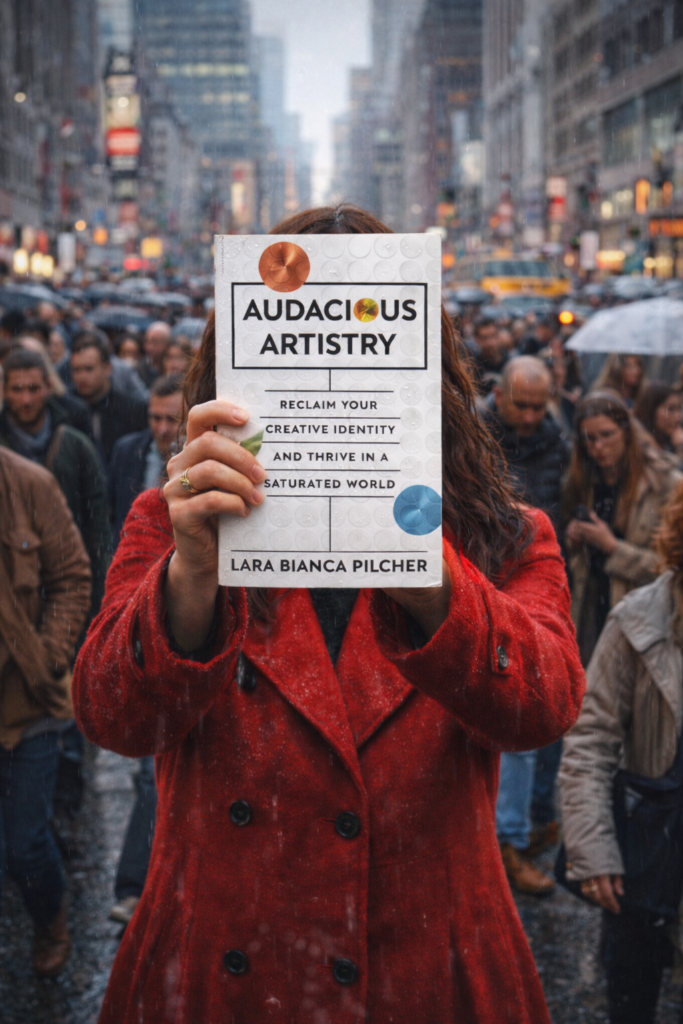
If this spoke to something in you, my book Audacious Artistry: Reclaim Your Creative Identity and Thrive in a Saturated World goes deeper into creative identity, success, rejection, comparison, and building a creative life without allowing outside approval to become the only measure that matters.
Go Deeper with Audacious Artistry
If this spoke to something in you, my book Audacious Artistry: Reclaim Your Creative Identity and Thrive in a Saturated World goes deeper.
You can also download the free 10-week group study guide and walk through the book on your own, with a friend or with a group of artists.
Find the book and free guide at: https://larabiancapilcher.com/book
It’s written for artists and creatives who still feel called to create but are tired of proving, comparing, waiting for permission, or wondering if their work still matters.
Read the book + get the free guide:
https://larabiancapilcher.com/book
This article is adapted from the Healthy Wealthy Wise Artist Podcast episode:
Listen to This Episode
“Why 10,000 Views Can Matter Less Than One Right Person“ on:
Or visit the podcast page:
https://larabiancapilcher.com/podcast
With you as you keep creating,
— Lara Bianca Pilcher
Connect with Lara
Website:
https://larabiancapilcher.com
Instagram:
https://instagram.com/larabiancapilcher









Build a life of love, purpose, adventure & boundless creativity!