


Listen to This Episode
“When Your Career Looks Smaller Than It Is” on:
When Your Career Looks Smaller Than It Is
There is a particular kind of shame artists do not talk about enough.
It happens when you place your credits, bio, follower count, income, or body of art beside somebody else’s—and your entire career suddenly looks small.
Their IMDb page is longer.
Their biography is filled with impressive names, companies, venues, and roles.
They have released four albums while you are still trying to finish your first.
They have 50,000 Instagram followers. You have 500.
They are the same age as you. Maybe they are younger.
And you cannot stop thinking:
I should be further along by now.
Artists Live with Visible Scoreboards
Every artistic field has its own currency.

Actors have IMDb pages, bookings, agents, and screen credits.
Dancers and musical theatre performers have biographies filled with companies, productions, choreographers, theatres, and tours.
Musicians have albums, streams, venues, and audience numbers.
Writers have book deals, sales, reviews, and publication lists.
Visual artists have exhibitions, commissions, sales, gallery representation, and followers.
These markers are not imaginary.
They can influence who gets trusted, booked, cast, published, represented, invited, or paid.
That is why it does not help to tell an artist, “Followers do not matter,” or, “Credits are just numbers.”
Sometimes the numbers do matter.
But they still do not tell the whole story.
The problem begins when we ask them to.
A Bio Cannot Hold a Whole Life
Almost every artistic event I attend asks for my biography.
That means I am regularly required to reduce decades of artistic life into a short paragraph.
A few hundred words must somehow hold performance, acting, teaching, writing, coaching, speaking, training, international moves, creative risks, and years spent working across different parts of the arts.
It cannot.
A bio is a summary, not a complete account.
Yet artists know that people often use that summary to decide how experienced, credible, or important we are.
We begin to feel ashamed of what is missing.
We see the gaps before anyone else has even commented on them.
We imagine the reader thinking:
“Is that all?”
When Experience Becomes Hard to Read
When I moved to Atlanta, I entered a market with a strong film and television industry.
I came with a long professional career and experience across theatre, musical theatre, performance, education, writing, speaking, coaching, and other parts of the arts. I had also trained and worked in film and television.
But every artistic market has its own language.
In a film and television market, people may look first for a particular set of screen credits.
When your career has been built across different countries, disciplines, and creative rooms, the full weight of your experience may not be immediately visible on the page someone is reading.
You can have a 20-year career and still look new in one particular market.
You can carry decades of experience while appearing to be starting again.
You can be deeply accomplished and temporarily difficult to read.
Knowing this does not always remove the sting.
It can still feel exposing when the public proof does not seem to match what you know you carry.
We Compare Results Without Comparing Conditions
Social media makes this even harder.
You see another artist’s 50,000 followers and compare that number with your 500.
What you cannot see in the number is when they began.
Perhaps they grew during a completely different period of Instagram, when organic reach was stronger and an audience could expand far more quickly.
Perhaps they entered a market at the right moment.
Perhaps they had access, support, money, time, health, contacts, or opportunities that shaped their growth.
This does not make their success less real.
It simply means you are comparing results without comparing conditions.
The visible number tells you what happened.
It does not tell you how, when, or under what circumstances it happened.
An IMDb page cannot show every stage you performed on, every student you taught, or every artistic skill you developed elsewhere.
A follower count cannot show the depth of your thought.
A short biography cannot show the years spent raising children, moving countries, recovering, rebuilding, earning money elsewhere, changing disciplines, or creating without recognition.
Visible proof is still proof.
But it is incomplete proof.
Shame Turns a Difference into a Verdict
Comparison may begin with a fact.
“They have more credits than I do.”
“They have a larger audience.”
“They have released more art.”
“They earn more money from their creativity.”
Shame then turns that fact into a verdict:
“They are a real artist, and I am not.”
“They are successful, and I have failed.”
“They have used their time well, and I have wasted mine.”
“Their career is significant. Mine is small.”
This is where comparison becomes destructive.
It is no longer helping you identify what you want to learn or where you would like to grow.
It is humiliating you.
And shame is a terrible teacher.
It rarely helps an artist make better art.
It makes us hide, hesitate, overthink, withdraw, and stop showing people what we are making.
Looking Less Accomplished Is Not the Same as Being Less Accomplished
Your career may genuinely have areas that need development.
You may need more training.
You may want stronger credits.
You may need to learn how a new market works, create a more focused body of art, improve your craft, pitch more often, or show up more consistently.
There is nothing wrong with wanting to grow.
The invitation is not to pretend that every artist is at the same level or that experience does not matter.
The invitation is to stop using another artist’s progress as evidence against your own.
Looking less accomplished is not the same as being less accomplished.
Sometimes your experience is real but not immediately legible.
Sometimes your career has depth that is difficult to summarize.
Sometimes you are carrying skills that have not yet found their most visible expression.
Sometimes you are building in a slower era, a different market, or under different conditions.
And sometimes you are still learning.
But you do not need to be ashamed of being an artist who is still learning.
Stop Looking into the Next Lane
I think about comparison like driving on a multi-lane highway.
You are in your car.
Another artist is travelling in the lane beside you.
They appear to be moving faster.
Their road looks clearer. Their car looks better. They seem to be reaching exits you hoped you would have reached years ago.
You become so focused on their speed that you stop paying attention to your own road.
You look sideways and ask:
“Do I look worthy yet?”
At some point, you have to turn your eyes forward.
Get in your car.
Stay in your lane.
Drive like the wind.
Staying in your lane does not mean refusing to learn or pretending you have no gaps.
It means you stop asking the artist beside you to decide whether your career counts.
Instead of asking:
“Why do they have more than I do?”
Ask:
What is mine to grow next?
That question does not shame you.
It moves you.
A Reflection for Your Creative Life
Think of the artist whose career currently makes yours feel small.
Then ask:
What am I using their career to say about mine?
Are you using their credits to tell yourself you are inexperienced?
Their followers to tell yourself you are irrelevant?
Their income to tell yourself you are unsuccessful?
Their opportunities to tell yourself you have missed your chance?
Name the verdict.
Then return to the question:
What is mine to grow next?
You do not need to become the artist in the lane beside you.
You need to keep driving your own creative life.
Your bio cannot hold your whole story.
Your follower count cannot measure your wisdom.
And another artist’s visible progress cannot decide whether your artistry matters.
Go Deeper with Audacious Artistry
If this episode spoke to something in you, my book Audacious Artistry: Reclaim Your Creative Identity and Thrive in a Saturated World goes deeper.
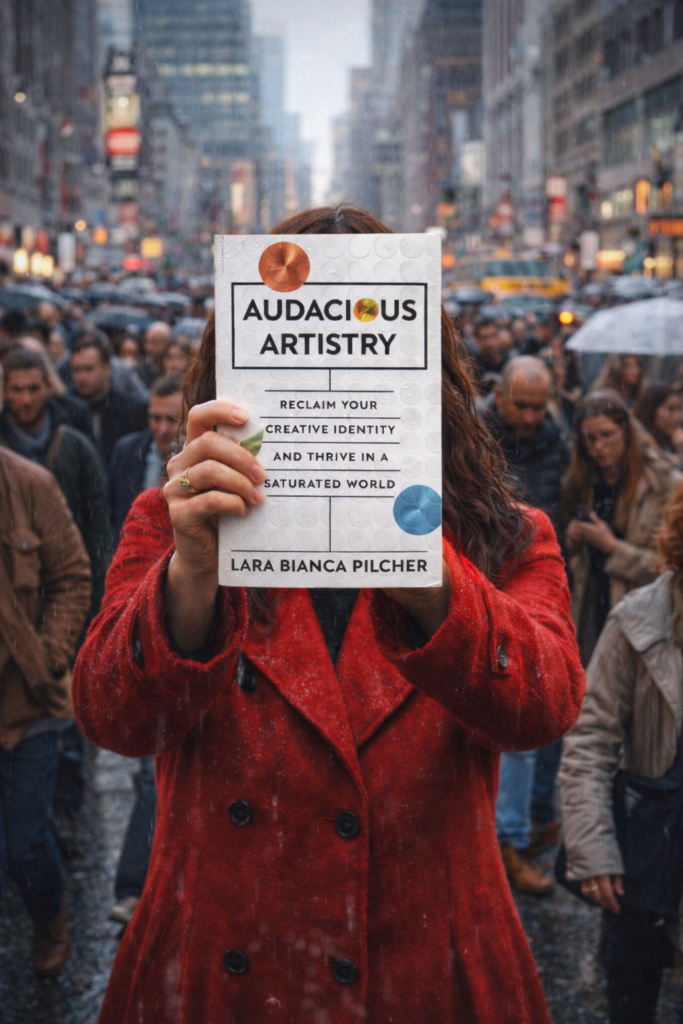
It’s written for artists and creatives who still feel called to create but are tired of proving, comparing, waiting for permission, or wondering if their work still matters.
You can also download the free 10-week Audacious Artistry Group Study Guide and walk through the book on your own, with a friend, or with a group of artists.
Read the book + get the free guide:
https://larabiancapilcher.com/book
This article is adapted from the Healthy Wealthy Wise Artist Podcast episode:
Listen to This Episode
“When Your Career Looks Smaller Than It Is” on:
Or visit the podcast page:
https://larabiancapilcher.com/podcast
With you as you keep creating,
— Lara Bianca Pilcher
Connect with Lara
Website:
https://larabiancapilcher.com
Instagram:
https://instagram.com/larabiancapilcher








Build a life of love, purpose, adventure & boundless creativity!